


Karen W.
my beagle scratched at her sides till id have to physically stop her, awful to watch. flare ups are way less now and her skin looks calm, wish id tried this before all the vet bills honestly
A veterinarian explains why Apoquel, steroids and prescription food stop working for so many itchy dogs, and the layer almost nobody treats.

If your dog's medication worked beautifully and then stopped working, that was never the medication failing you. It was aimed at the wrong layer.
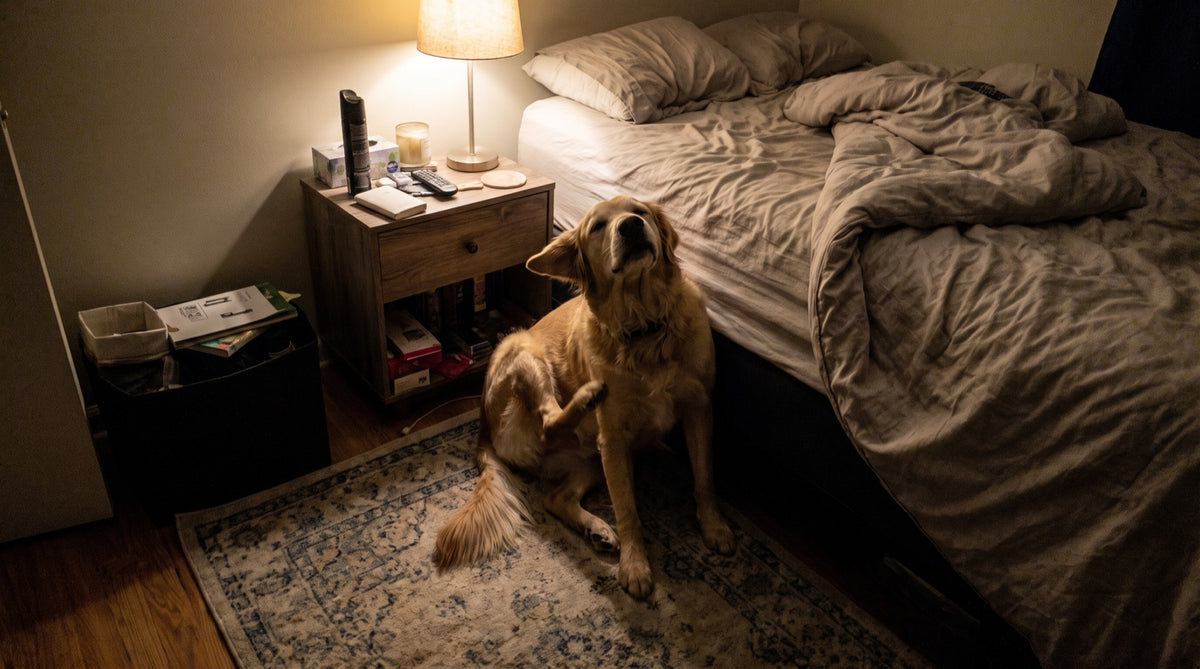
Every week in my exam room I meet a dog who has been itching for years, and an owner who has already tried everything I would suggest.
They sit down with a folder, or a note on their phone. They are tired. Most have not slept properly in a long time.
They tell me versions of the same four stories.
"The Apoquel worked in two days. Then after a few weeks it stopped doing much. My vet said we could go up a dose."
"We did the Cytopoint shot. It held for about a month. Then the itching came right back."
"We have switched her food four times. We are on the fifth now. I do not know what I am supposed to feed her."
"I have spent thousands. She is still red and itchy. She is just not bleeding from it anymore."
That last sentence stays with me, because of what it accepts. Not bleeding has become the good outcome.
These owners are not lazy and they are not gullible. They are the most diligent clients I have. They did the food trials. They did the baths. They gave the medication exactly as directed.
In nineteen years I have not seen these cases get rarer. I have seen them get longer. The dog who itched for two weeks one spring is the dog who itches half the year two springs later.
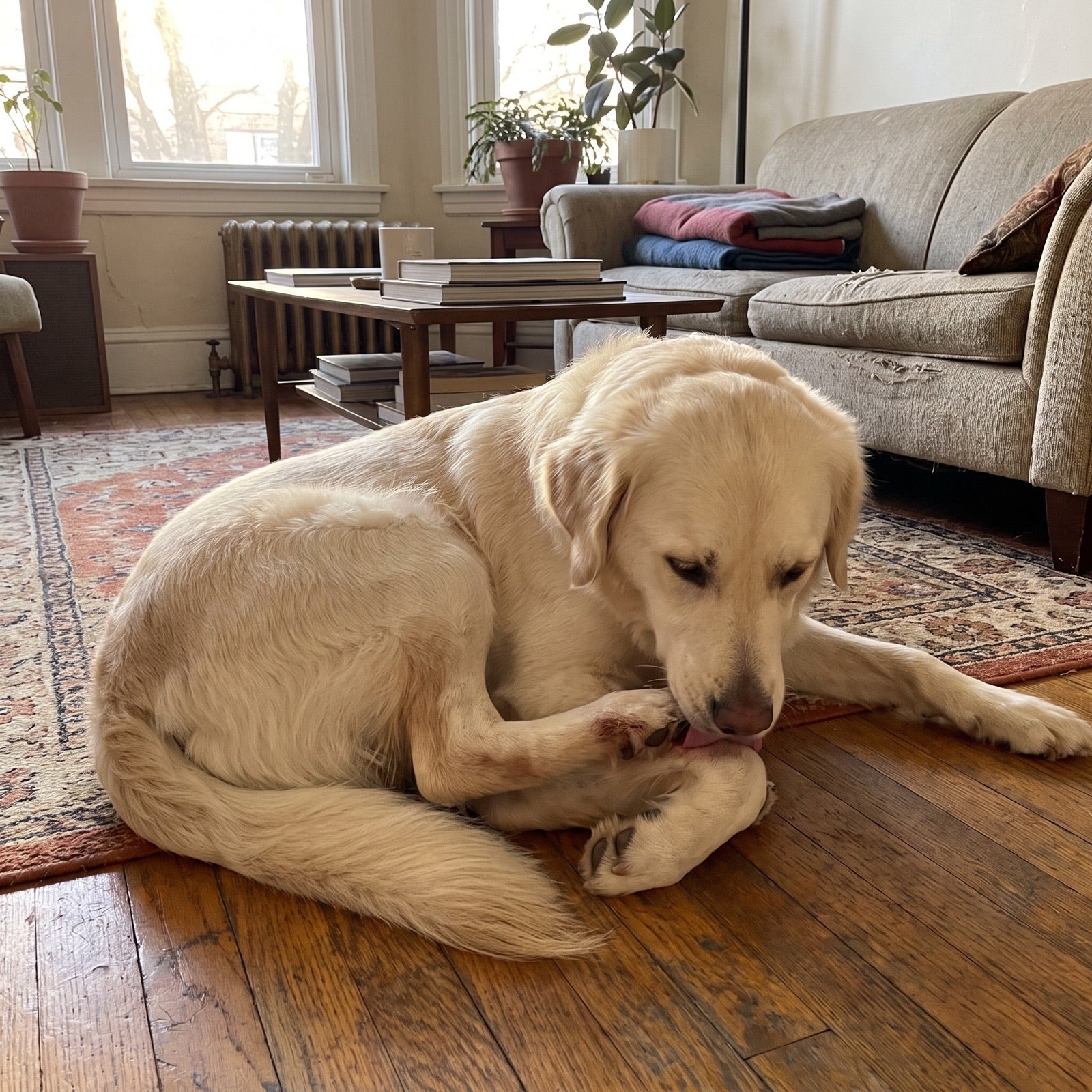
So here is what I now tell every owner with that folder.
The problem is almost never that your dog needs something stronger.
The problem is that everything in the folder was aimed at the itch.
Your dog's scratching is not the disease. It is the alarm.
Something further back has stopped holding. You can switch off the noise as often as you like. It will keep going off until somebody deals with what is setting it off.
Let me show you what I mean.
Last spring a client I will call Diane sat down in my exam room. She was sixty-one. Her golden retriever, Sadie, was seven, and had been itching for four years.
Nobody had ever told her why it started. The file said "atopy, environmental," which in plain English means the skin is over-reacting and we do not know to what.
Not knowing the cause had never stopped anyone from treating it. Including me.
Diane kept a note on her phone of what she had spent. She turned the screen around so I could read it.
What Diane had already tried:
Her vet had also referred her to a dermatologist. The first appointment plus testing was quoted at about $1,800. She never booked it. That is not in the total either.
And after all of it, Sadie still woke the house at three in the morning. The thump of a back leg going against the floorboards. Then the tags jingling. Then the wet clicking sound of a dog working on her own front paw in the dark.
Then Diane told me the part I think about.
"I moved her out of the bedroom about eight months ago," she said. "I had to. My husband gets up at five. I was awake three, four times a night. So now she sleeps in the kitchen."
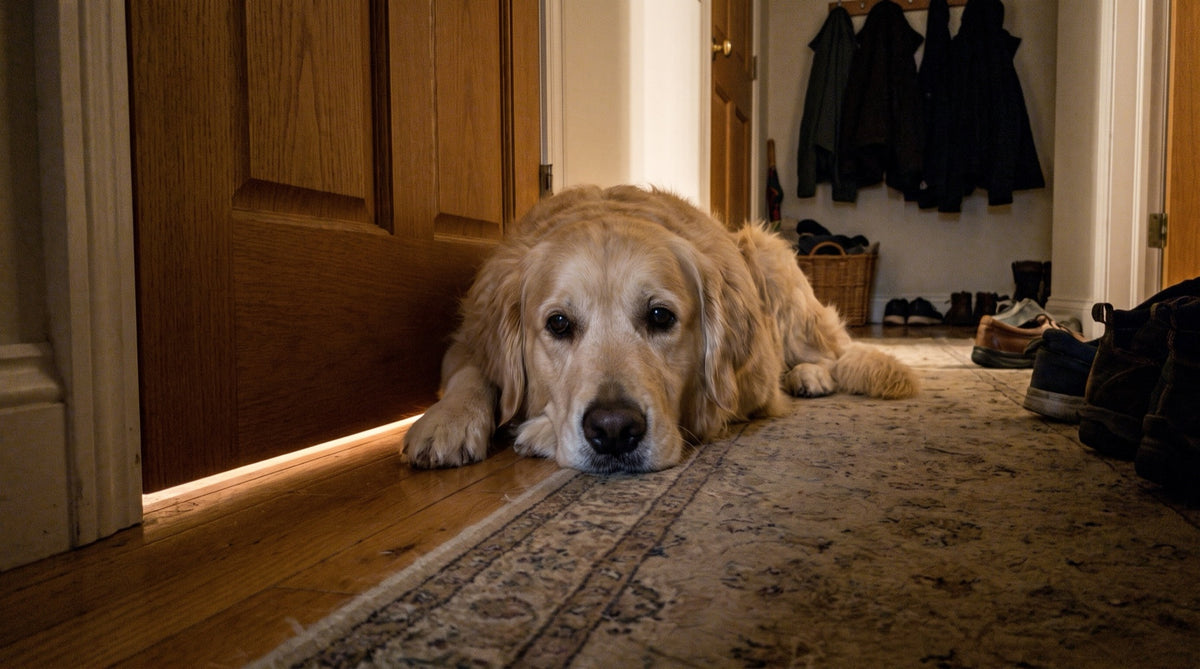
"She still comes up the stairs at bedtime. Every night. She stands in the doorway and waits."
"And I close the door on her."
Diane stopped for a second.
"I have had her since she was nine weeks old. I sat on the floor on my side of that door for a long time the first night."
I hear a version of this most weeks. Not always the bedroom. Sometimes it is the good rug, or the couch, or the grandchildren's visits.
The itch takes the dog's comfort first. Then it takes the part of the relationship the owner loved.
Diane did not fail Sadie. I want to show you why that list was never going to work, and I should say up front that I helped write part of it.
Almost everything on it was aimed at the same layer. The layer you can see.
Apoquel and Cytopoint. These reach into the itch-signalling system and quiet the signal. That is exactly what they were designed to do, and they do it well. Owners are often amazed by how fast they work. But quieting a signal does not repair anything. When the medicine wears off, the signal comes back, because whatever was setting it off never stopped.
Verdict: the alarm goes quiet. The gap stays open.
Steroid courses. Prednisone turns the whole immune response down. It buys a calm month. It is also a blunt instrument, and every vet I know watches the calendar on it.
Verdict: turns down everything. Fixes nothing.
Antihistamines and Benadryl. Cheap, safe, easy, and for most chronic cases they take the edge off at best.
Verdict: takes the edge off, and that is all.
Medicated shampoos, sprays, wipes and creams. These genuinely help the surface. They wash away what is sitting on the skin. The trouble is that the trigger keeps arriving from somewhere else, so Thursday looks like Monday.
Verdict: clean dog, same problem.
Food changes, novel proteins and elimination diets. These are worth doing, and for a small number of dogs they solve it outright. For most of the dogs I see they help partway and then stall, because the itch was never one single trigger.
Verdict: pull one out and the others keep going.
Allergy testing. A panel gives you a list. It does not give you a repair. Owners often spend the money and come away with an expensive piece of paper telling them their dog reacts to grass, which they cannot remove from the world.
Verdict: you get a list. You wanted a repair.
Fish oil, omegas, skin and coat chews. Many of these support the skin from the inside and I do recommend them. But they are working downstream, on the part of the story that has already gone wrong.
Verdict: helpful, and too far down the line.
Look at that list again. Seven approaches. Different companies, different prices, different mechanisms.
Every one of them shares the same flaw.
Not one was designed to rebuild the barrier that is letting the trouble in.
They manage what leaks through. Nothing in the list looks at why it is leaking.
I did not run another test on Sadie. Diane had paid for enough tests.
I asked her a question instead. It is not one that comes up much.
"How old was she when it started?"
Diane thought about it. "Two and a half. Maybe three."
That is the age I hear more than any other. It is the reason I stopped starting these conversations at the skin.
Here is the piece almost nobody gets told.
Your dog's body makes its own collagen. Collagen is the structural material she uses to build and repair barriers: the gut lining, the skin, the joint cushion, the connective tissue in between. Think of the cells as bricks and collagen as the glue between them.
A puppy makes it in abundance.
Then production starts falling, beginning around age two. We call it the Collagen Cliff.
By middle age a dog is holding a whole body's worth of barriers together with a fraction of the material she had as a pup. The body rations what is left. It cannot keep every wall sealed at once, so the weakest wall shows it first.
For one dog that is the joints. For another it is the coat.
For an enormous number of the dogs I see, it is the gut wall.
Diane went quiet. Then she said the thing owners always say here.
"Why has nobody ever told me this? Four years. Four different people."
This is the part I have to be careful about, because I am one of those people.
It is not that your vet does not care. Your vet has fifteen minutes, a full waiting room, and a training built to identify the trigger and calm the reaction.
There is no line on the invoice for rebuilding a barrier over eight weeks.
Here is the part that appointment does not have time for.
The itch does not start on the skin. For a great many dogs it starts one layer back, in the gut wall.
That wall is thin, and it is held together by collagen. Picture a window screen. When the mesh is tight, only what should pass through passes through. Nutrients cross. Everything else stays outside.
When the glue holding that mesh runs thin, small gaps open between the cells.
Half-digested food and everyday particles slip through into the bloodstream, where the body was never meant to meet them. The immune system treats them as invaders and sounds the alarm.
That alarm is the itch.
It comes out as hot spots. Rusty brown paws. The yeasty corn-chip smell on the feet. Red skin on the belly. Ears that clear up and come back. And the licking at three in the morning.
Now the question you should be asking. Why would your dog be short of collagen?
Three reasons, and at least one of them is certainly true of your dog.
Her age. Production starts dropping from around two. There is no dog over the age of two on the near side of that cliff. It happens quietly inside every aging dog, and there is nothing you did to cause it.
Her bowl. Dogs used to get a collagen top-up from food. Wild and older-style diets included the parts that are loaded with it: skin, cartilage, tendon, connective tissue. Modern kibble is built mostly from muscle meat, starch and filler, and most of that connective material is processed out. So a lot of dogs get hit twice. Internal production falls, and the old food-based top-up is gone.
The flare itself. This is the one that catches owners out. Every scratch breaks skin that then has to be rebuilt. Every flare leaves the lining a little more open than before. Repair costs material she is already short of, so the problem quietly feeds itself.
That is why managing an itch rarely holds it flat. It slides. Every year it starts a little earlier and runs a little longer, slowly enough that nobody in the house notices it happening.
There is one more piece, and it is the piece that ruins the obvious solution.
Collagen on its own is only raw material. It is bricks stacked on the driveway.
The body needs vitamin C to build with it. That step is settled biochemistry, and it is the one everybody skips.
How it actually happens
It begins somewhere around age two and keeps going. Nothing you did caused it and nothing you feed her stops it on its own.
Collagen is the structural material in the gut lining and the skin. As supply drops, that wall gets easier to irritate and things cross it that should not.
It reacts to what got through. That reaction lands on the skin as redness, chewing, rusty paws and the licking at three in the morning.
So the itch you are treating is step three. The shortage is step one.
Before I tell you what I changed with Sadie, I have to clear three things out of the way. I hear all three every week, and each one keeps a dog itching.
This is the most natural conclusion in the world, and it is the wrong one. A stronger suppressant is still a suppressant. Going up a dose gets you a quieter dog and the same open barrier underneath. You are turning the volume down on a fire alarm while the fire is still in the wall.
I want to be careful here, because your vet is not the villain of this article. I am a vet.
Your vet is downstream of the same information gap you are. The system is built to identify a trigger and suppress a reaction, and it is genuinely excellent at that. Rebuilding a barrier takes eight weeks and nobody gets paid for it.
There is a quieter truth underneath. A problem that gets managed forever is not a failure for anybody selling the management.
Yes, some breeds are more prone to this. Yes, it does tend to get worse as a dog gets older.
But "prone to it" is not the same as "fixed at this level." The severity is not written in stone.
Old is not a mechanism. A wall running short of glue is a mechanism, and a mechanism is something you can work on.
That is the difference between managing a dog and rebuilding one.
After nineteen years of watching the same note appear on the same phone, I have come to a simple conclusion.
If you want to work on the cause of a chronic itch rather than the signal, three things have to be true.
Not one.
Not two.
All three.
The barrier is built from collagen. If it is thin because collagen ran short, the first requirement is obvious. Put the material back.
Now go through the cabinet and find anything that does that.
Apoquel. Cytopoint. Prednisone. Antihistamines. Medicated shampoos, sprays and ear flushes. A hydrolyzed diet. Every one works on the alarm or on the trigger.
Not one of them puts back a single milligram of the material the barrier is made from.
That is not a criticism of the medication. It was never failing you. It did exactly what it was built to do. It was just never built to close the gap.
This is where the obvious answer falls down.
A tub of plain collagen powder delivers bricks to the driveway. Nothing in the tub tells the body to build with them.
Collagen needs vitamin C to be put to work. That is settled biochemistry, and it is why a single-ingredient collagen product is incomplete.
Then there is the layer you can see. Biotin carries the story out to the skin and coat, the part an owner can actually watch. Hyaluronic acid brings the moisture that keeps skin and cushion from drying out.
Requirement 2 rules out two things at once.
Anything with a single ingredient in it.
And the opposite mistake, the very long label. A serving only has so much room. Every extra ingredient means a smaller dose of everything else, and one more thing for a reactive dog to react to. A long label is often a pinch of everything and a dose of nothing.
This is the requirement almost every product on the shelf fails, and the one owners underestimate.
To press a powder into a chewable shape you need a base. Starch. Pea or rice flour. Binders. A flavor system. Something to hold the shape on a warm shelf.
The active is a sliver inside a brick. The whole brick has to be chewed, swallowed and broken down before any of it works.
There is a second problem with the brick, and it is worse. A dog with a reactive gut is exactly the dog who may react to the base it is pressed into. So the allergy support chew bought to be gentle can quietly feed the thing it was sold against. She did everything right, and the format worked against her.
Then comes the daily tax, the one that kills results.
Pill surgery. Wrapping it in cheese. The betrayal face. Eating around it for a week, then spitting it out.
A dose your dog refuses is a dose of nothing.
For years I told owners there was no clean way to do all three at once. The best we could do was stack approaches and hope.
Then a client brought something into my consult room that changed how I handle these.
A woman in her seventies with a very itchy cocker spaniel put a small blue glass bottle on my table and asked whether it was nonsense.
I expected it would be.
I have read a lot of dog supplement labels. Most are a long ingredient list, a proprietary blend, and no amounts printed anywhere.
Then I turned it over and read the panel.
Four active ingredients. Every one with its amount printed next to it. No proprietary blend, and nothing there to bulk it out.
And it was a liquid. That matters more than it sounds, because a liquid has no brick. There is nothing to press, bind or dissolve. It goes on top of the food the dog already wants. Drops instead of bricks.
The product is Nature's Paw Premium Liquid Collagen. It is a bacon-flavored liquid you pour over the food your dog already eats. It is crafted by vets, and it is the only thing I have found that meets all three requirements at once.
Here is how it maps.
Requirement 1: the material. 400 mg of certified grass-fed collagen peptides per 1 mL serving. That is the raw material the body uses to build and patch linings, walls and cushions. It is the thing in decline since she was two.
Requirement 2: the crew that uses it. The same serving carries 20 mg of vitamin C, 1.5 mg of biotin and 1.0 mg of hyaluronic acid. Vitamin C lets the body put the collagen to work. Biotin feeds the layer you can see. Hyaluronic acid holds moisture in the skin and cushions the joint. Nature's Paw calls the four the Bio-Active 4, and the phrase is accurate. They only make sense as a set.
Every one of those amounts is printed on the bottle. A short label is the proof. There is no room to hide a token pinch of anything when there are four things on it.
Requirement 3: it gets in. A bacon-flavored liquid handles both taxes. There is no filler base for a reactive dog to react to, and no wrestling match at dinner.
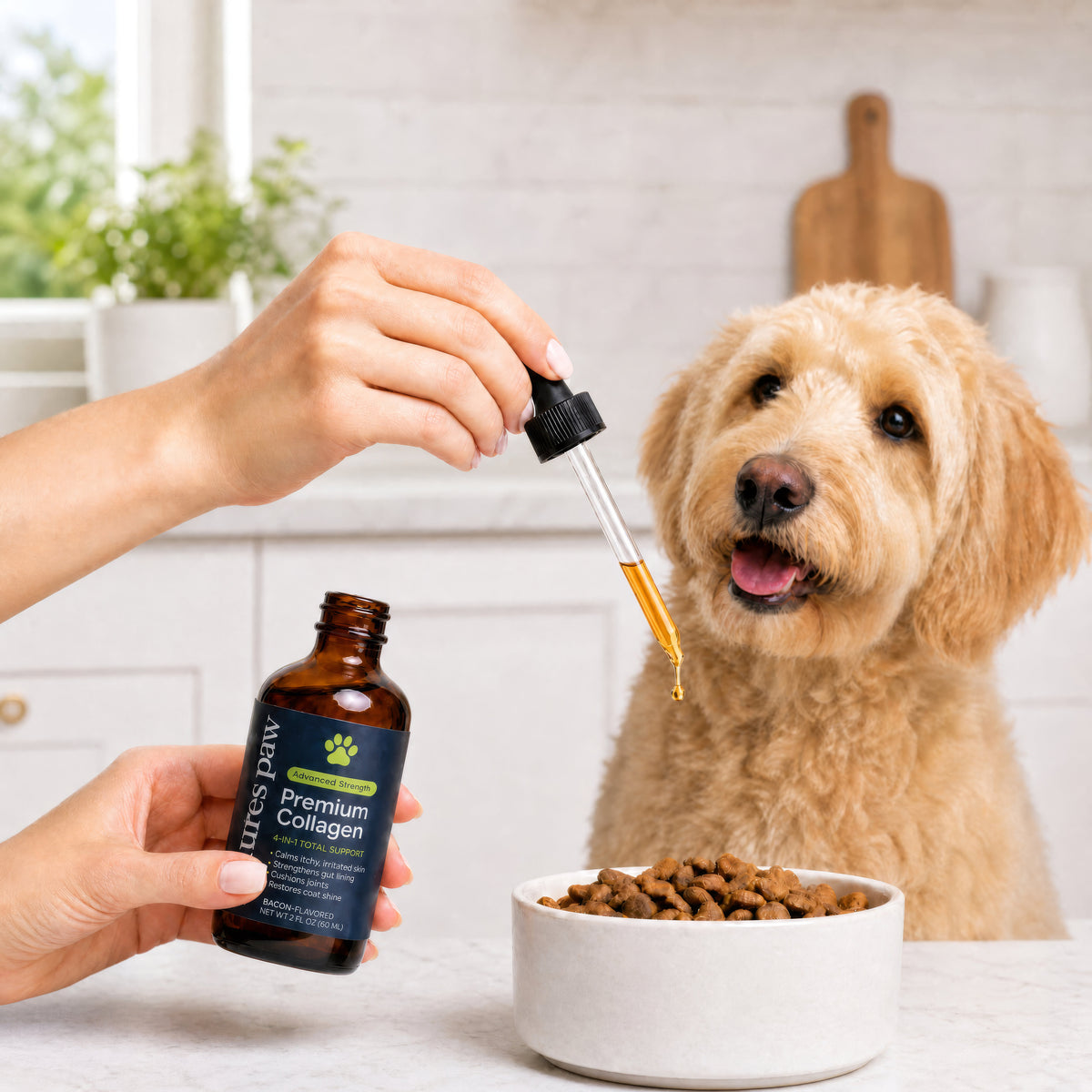
Here is the whole thing, start to finish.
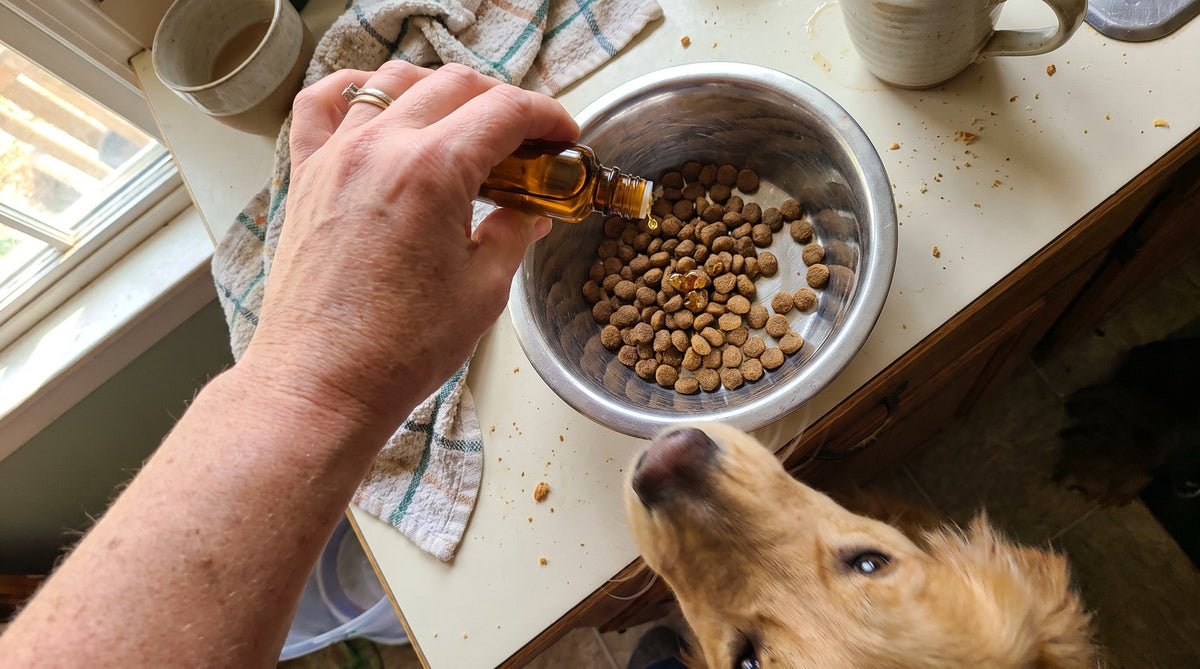
Dinner time. You draw the dose with the dropper, or you pour it using the cap. A dog under 10 lb takes 1.0 mL. Up to 25 lb, 1.5 mL. Up to 50 lb, 2.0 mL. Over 50 lb, 3.0 mL. You drizzle it over whatever she already eats, whether that is kibble, fresh or raw.
She eats it. It smells like bacon, so for most dogs this is the easiest part of the day. She thinks she is getting something.
The first two to three weeks. This is the quiet stretch. Underneath it, the four actives are going to work on the lining first, because that is the wall closest to where they arrive.
Weeks four to eight. Typically the deeper changes show up in this window. The order tends to be the same: the gut and the licking settle first, the coat comes after that, and stiffness is last because a joint cushion is the slowest thing on the list to rebuild.
That sequence is worth knowing, because it is the tell. Something that only masked a symptom would change everything at once, or nothing at all.
That is the whole routine. It takes about five seconds at the bowl.
Nothing is being switched off. You are not suppressing a signal here. So there is no signal sitting behind a dam, waiting to flood back the week the bottle runs out.
Your dog does not build tolerance to a building material. Collagen, vitamin C, biotin and hyaluronic acid are things the body already runs on. There is no dose that has to keep climbing to hold the same ground.
It works alongside what she is already on. This is a supplement rather than a drug, and many owners start it while their dog is still on a prescription. Some later find they need the medication less often. That is a conversation to have with your own vet, and you should never stop a prescription on your own.
There is nothing to argue about at dinner. Nothing to hide in cheese, nothing to spit out behind the couch. That sounds like a small thing. It is the single biggest reason supplements fail, because owners quietly give up around week two.
And the label is four things with their amounts on it. Free of chicken, grains, brewer's yeast, pea starch and artificial ingredients. No fillers or binders, because there is no shape to hold together.
I gave Diane a bottle and asked her to use it every day and come back in eight weeks.
She emailed me at about week three.
"The licking has stopped waking me up. Not gone. But I slept until the alarm twice this week."
At the eight week appointment, Sadie's paws had gone from rust-brown to something close to normal. The smell was mostly gone. There was hair growing back on one flank.
Diane was careful with how she put it. I want to be equally careful.
"She still scratches," she said. "I want to be clear about that. It is not gone. It went from constant to occasional."
Then she got to the part that mattered.
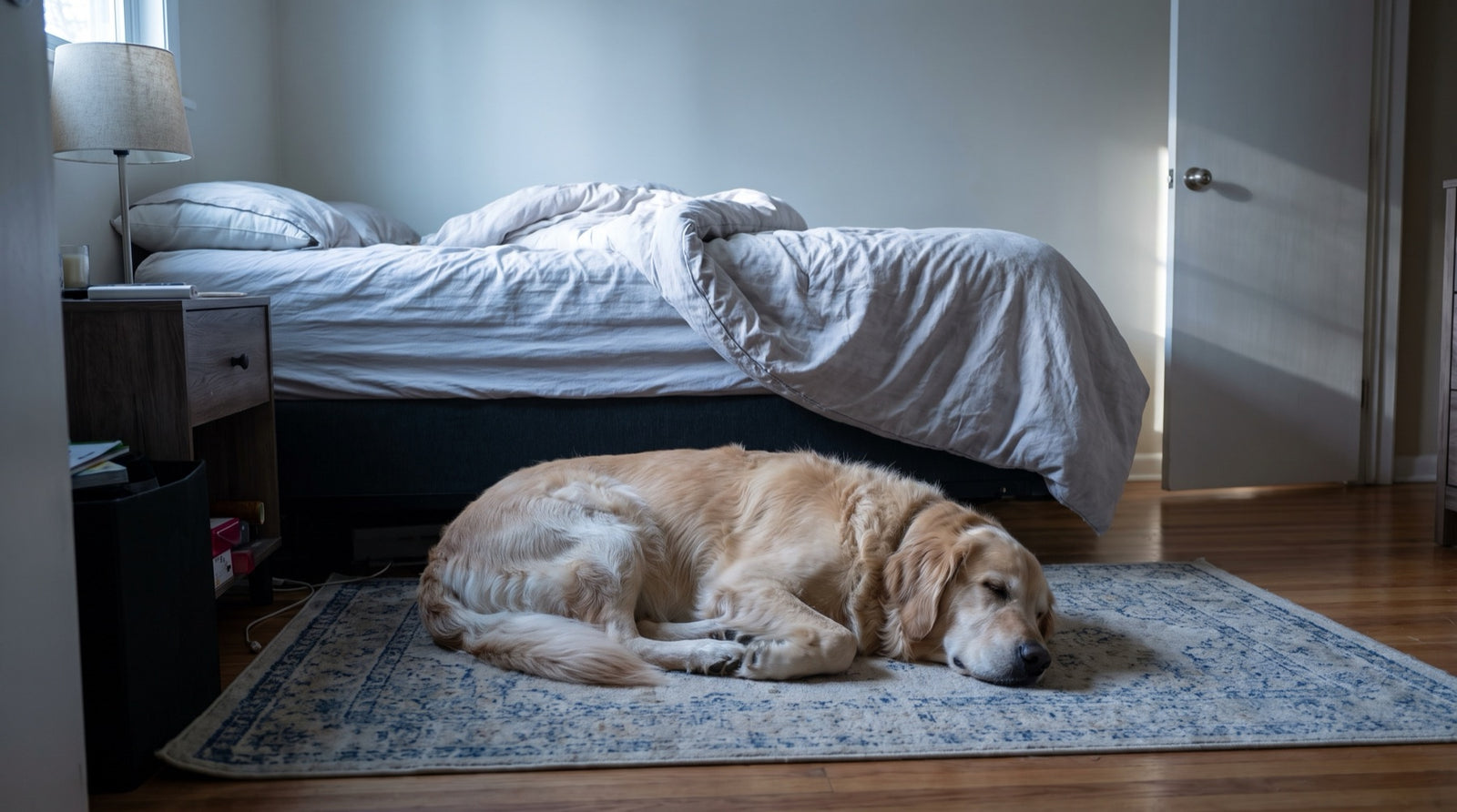
"She is back in the bedroom. She sleeps on the rug at the end of the bed. She has been there about a month."
"I do not close the door on her anymore."
I have been recommending this to clients for a while, and I stopped being able to call it one dog's fluke some time ago. On the product page, Nature's Paw Premium Liquid Collagen carries 4.8 out of 5 from 192 Judge.me reviews.
Now the part most articles leave out.
Not every dog responds. Some owners write in at week four and say they have seen nothing at all. That is a real outcome. Some dogs are slower and only change well into the second month. Some do not like the smell.
Owners typically report early changes somewhere in the 14 to 21 day range, with deeper change over four to eight weeks. Typically. Not always, and never on a promise.
If you have already made up your mind about trying it, you do not need the rest of this article. See it on the Nature's Paw page
The rest covers what other owners reported, what it costs, and what to do if it does not work for your dog.
I am not the only person seeing this. These are reviews published on the Nature's Paw product page, printed exactly as they were written, spelling and all.
Karen W.
my beagle scratched at her sides till id have to physically stop her, awful to watch. flare ups are way less now and her skin looks calm, wish id tried this before all the vet bills honestly
Read that last clause again. "Wish id tried this before all the vet bills." That is the same note on the same phone, written by somebody else.

Debra S.
my picky shepherd actually eats it and hes scratching way less now
That is a four-star review and I would rather show it to you than not. Note what she led with. Not the itch. The fact that her picky dog eats it. Requirement 3 is the one owners feel first.

Dave R.
honestly didnt think it would work but the paw licking has basically stopped. just put it in her food she doesnt even notice
He starts where you are starting. And what he reports is the paw licking, the part that wakes a house up.

Marie C.
coat is shinier and the ear gunk is way down. took a star off cause the price made me wince at first but one bottle lasts a while on my little dog so its not bad really
The ears and the coat are the corroborating symptoms. When those move, something upstream has usually moved first. And she argued herself out of the price without any help from me.

Wayne S.
cold mornings used to make my shepherd so stiff, loosening up way faster now
That one is about stiffness rather than itch, and I include it deliberately. Same shortage, different wall.
Notice what these reviews do not say. Nobody says the itching vanished. Nobody uses the word cure.
The three-star reviews sit on that same page. Read those as well. They are the ones that tell you what this is actually like.
That is what a real review pile looks like, and after nineteen years of reading the other kind, I find it more convincing.
I understand the hesitation completely.
You have been disappointed before. You have paid for the thing that was going to be different, more than once. A healthy suspicion of an article like this one is not a flaw. At this point it is a survival skill.
So here is the only reason I am comfortable pointing owners at this.
Nature's Paw covers your first order with a 60-day money-back guarantee.
That is not thirty days. Sixty days is long enough to run the trial properly: past the quiet first couple of weeks, into the four-to-eight-week window where deeper changes usually show up, and out the other side with an answer.
If you are not happy with the product or the results, you email support@trynaturespaw.com and they will make it right.
I will tell you what I take from a term like that. A company only writes a sixty day window when it expects most people to still be using the bottle on day sixty.
You already know what another year of managing this looks like. Weigh the bottle against that.
Nature's Paw Premium Liquid Collagen lists at $50 a bottle.
The Subscribe and Save pricing on the product page runs like this:
Those are subscription prices. The order repeats, and each renewal bills at the same price plus $2.99 shipping. A one-time bottle is $36.99, and shipping is $2.99 on that too.
Put that next to Diane's note. $2,810 over four years, and that total left out the shampoos, the wipes and the salmon oil, and the $1,800 dermatology quote she could not face booking.
It is sold in one place. Nature's Paw is not on Amazon and not in stores.
On quantity, do the arithmetic for your own dog. A 60 mL bottle holds sixty 1 mL servings, and the dose climbs with weight. A small dog reaches day sixty on one bottle. A 40 lb dog needs two. A dog over 50 lb needs three.
If the page is taking orders, it is in stock.
Every week you wait is another week of the thump against the floorboards at three in the morning.
Another morning where you are tired before the day starts.
Another week where the dog sleeps somewhere she never used to.
You have already tried the medication that worked beautifully and then stopped. You have already tried the food that cost more than yours. You have already tried the shampoo, and the wipes, and the tub of chews she stopped eating.
None of those were designed to do the three things that matter:
Nature's Paw Premium Liquid Collagen is the only thing I have found that does all three.
It will not settle four years of itching in a weekend, and I would not trust anybody who said it would. The first couple of weeks are usually quiet.
But it is the one job in this whole story that nobody in the loop is doing.
If you have got to this point in the article, you are not browsing.
You are looking for the thing that finally works, and you have been looking for a long time.
You have almost certainly read pages like this one before. You have seen the ads. You have been let down enough times that part of you is already reaching to close the tab and keep looking.
I understand that instinct better than you might think. I have watched clients arrive at that exact point in my exam room.
But consider what has actually happened in the last twenty minutes.
You now know something about your dog that four years of appointments did not give Diane. You know her collagen production has been falling since she was about two. You know the gut wall is held together by that material. You know why the medication worked brilliantly and then stopped, and that this was never the medication failing you.
That understanding does not expire. What it changes is what you do next.
And what you do next is worth being honest about, because there is no neutral option here. The itch does not sit still. It slides. Every year it starts a little earlier and runs a little longer, and every flare leaves the lining a little more open than the last one.
Six more months of managing it is six more months of the tags jingling at three in the morning, and six more months of paying for it.
Diane spent $2,810 and four years before anybody talked to her about the layer underneath. She did not do anything wrong. Nobody told her.
You have been told.
The 60-day money-back guarantee is why you do not have to be certain today. If it does nothing for your dog, you email support and they make it right. What you cannot get back is the year.
One pour a day, on the food she already eats. That is the whole ask.
Where to get it
Nature's Paw Premium Liquid Collagen

Prices shown include the 20% automatic-refill discount, which is selected by default. A one-time purchase is available on the same page at $36.99 a bottle. Shipping is $2.99.
See pricing and availability On the official Nature's Paw pageSold in one place only. Nature's Paw is not on Amazon and not in stores.
Covered by the 60-Day Money-Back Guarantee
Different jobs. Apoquel and Cytopoint act on the itch-signalling system to quiet the signal, and they do it well. Nature's Paw is not a drug. It supplies collagen peptides plus the vitamin C, biotin and hyaluronic acid the body uses to build with them. One quiets the alarm. The other works on the material the barrier is made from.
Yes. It is a supplement rather than a medication, and it works alongside a current treatment plan. Many owners start it while their dog is still medicated. If your dog has a medical condition, talk to your vet first.
That is a decision for you and your vet, and never one to make on your own. Some owners find over time that their dog needs the medication less often. That is a conversation for your next appointment.
Format. To press a powder into a chew you need a base: starch, flour, binders, a flavor system. The active sits inside that. A liquid has no shape to hold, so there is no base at all. It goes straight onto food the dog already wants.
This is the most important question here, so here is the long answer. Plain collagen is raw material and nothing more. Bricks on the driveway. The body needs vitamin C to build with it, and that step is settled biochemistry, so a single-ingredient collagen product is incomplete from the start. Second, most powders print no amounts at all, so you have no idea what your dog is getting. Nature's Paw prints all four: 400 mg collagen peptides, 20 mg vitamin C, 1.5 mg biotin and 1.0 mg hyaluronic acid, per 1 mL. Third, and this quietly decides everything, a powder has to be eaten every day for weeks. Most owners stop around week two because the dog stops cooperating.
Individual results vary. Owners typically report early changes somewhere in the 14 to 21 day range, with deeper change over four to eight weeks. The order tends to be consistent: the gut and the licking settle first, the coat follows, stiffness last.
Some dogs do not respond, and I would rather say so. That is what the 60-day money-back guarantee on a first order is for. If you are not happy with the product or the results, email support@trynaturespaw.com and they will make it right.
Once a day, drizzled over food. Under 10 lb, 1.0 mL. 11 to 25 lb, 1.5 mL. 26 to 50 lb, 2.0 mL. Over 50 lb, 3.0 mL. Suitable for dogs over 12 weeks. A 60 mL bottle holds sixty 1 mL servings, so it lasts sixty days for a small dog, thirty for a 40 lb dog and twenty for a big one. Work out your dog's dose first, then pick the quantity.
It is bacon-flavored and goes on top of food she already likes, which is usually why this is the easy part. Not universal though. Some owners tell us their dog does not like the smell.
Two worth knowing. Some owners find the smell strong, which is fair on anything bacon-flavored. And some report the glass dropper does not always draw properly. If that happens, pour the dose using the cap. Better that you hear it here.
You are currently shipping to United States and your order will be billed in USD $.